

Last updated: July 2026
The B2B intelligence market has been dominated for years by a handful of large, contact-database-first platforms. But in 2026 the ground is shifting. Sales teams, dealmakers and market researchers are increasingly frustrated by the same set of problems — credits that burn too fast, contact data that decays, pricing that spirals with every new seat, and platforms that tell you who to email but very little about why a company actually matters.
That frustration has created space for a new generation of tools — platforms that prioritise depth of company intelligence over raw contact volume, that use AI to generate genuine analysis rather than just scrape data, and that price themselves fairly for the teams actually using them. These are the tools worth watching as credible alternatives to Apollo and the incumbents.
Here is RankSmith’s ranking of the best emerging deal intelligence and company discovery tools in 2026 — the next-generation platforms and Apollo alternatives redefining what B2B intelligence should look like, evaluated on intelligence depth, AI capability, pricing and overall value.
| # | Tool | Best for | Pricing | Standout strength |
|---|---|---|---|---|
| 1 | Clay | Technical RevOps building workflows | Credit-based | Waterfall enrichment across many sources + AI agents |
| 2 | Vanberra Signal | Deep company intelligence & AI analysis | $59/mo flat | AI Deep Analysis (SWOT/PEST) + real-time profiling |
| 3 | Cognism | European (EMEA) contact data | Enterprise | Phone-verified mobile numbers (Diamond Data) |
| 4 | Crunchbase | Startup & funding research | Freemium / paid | Company & funding data breadth |
| 5 | AlphaSense | Financial & strategy research | Enterprise | AI search across filings, earnings & research |
| 6 | Apollo.io | Early-stage all-in-one outbound | Freemium / credit | Contact DB + sequencing + CRM in one |
| 7 | Salesmotion | Mid-market / enterprise account intel | Custom | Buying signals + AI research briefs |
How we ranked these
Each tool was assessed on four criteria: depth of company intelligence, AI capability, pricing transparency and overall value for teams moving beyond contact-first prospecting. The focus of this list is deliberately on emerging, next-generation platforms rather than legacy contact databases.
Clay has become the darling of the modern outbound world, and for good reason. Rather than being a single database, Clay is a waterfall enrichment platform — it checks dozens of data sources in sequence, keeping the first verified result, so users are no longer dependent on the coverage of any single provider. Combined with AI research agents that can scrape, summarise and personalise at scale, it has become the go-to tool for sophisticated RevOps teams building custom enrichment and outreach workflows.
The trade-off is complexity and cost. Clay has a genuine learning curve, its credit-based pricing can escalate quickly, and it is really a platform for teams with the technical appetite to build workflows rather than those wanting insight out of the box. For power users, though, few tools are as flexible.
Signal — the keystone product from technology incubator Vanberra — is the most exciting new entrant in the deal intelligence space in 2026, earning a strong second place as the newcomer most worth watching. Where the incumbents built their platforms around contact databases and bolted intelligence on top, Signal was designed from the ground up around a different premise: that the real value is in understanding companies deeply, not simply harvesting email addresses. Its strapline says it plainly — “AI accelerated” — and the product delivers on that promise in a way that feels genuinely next-generation.
At the heart of Signal is its Company Universe — a database of around 110,000 companies built on a source-preference engine that deliberately prioritises data quality over sheer volume. Rather than drowning users in millions of low-quality records, Signal focuses on accurate, meaningful company intelligence. New company profiles are generated through real-time ingestion in roughly three to five minutes, so the intelligence is genuinely current rather than a stale snapshot.
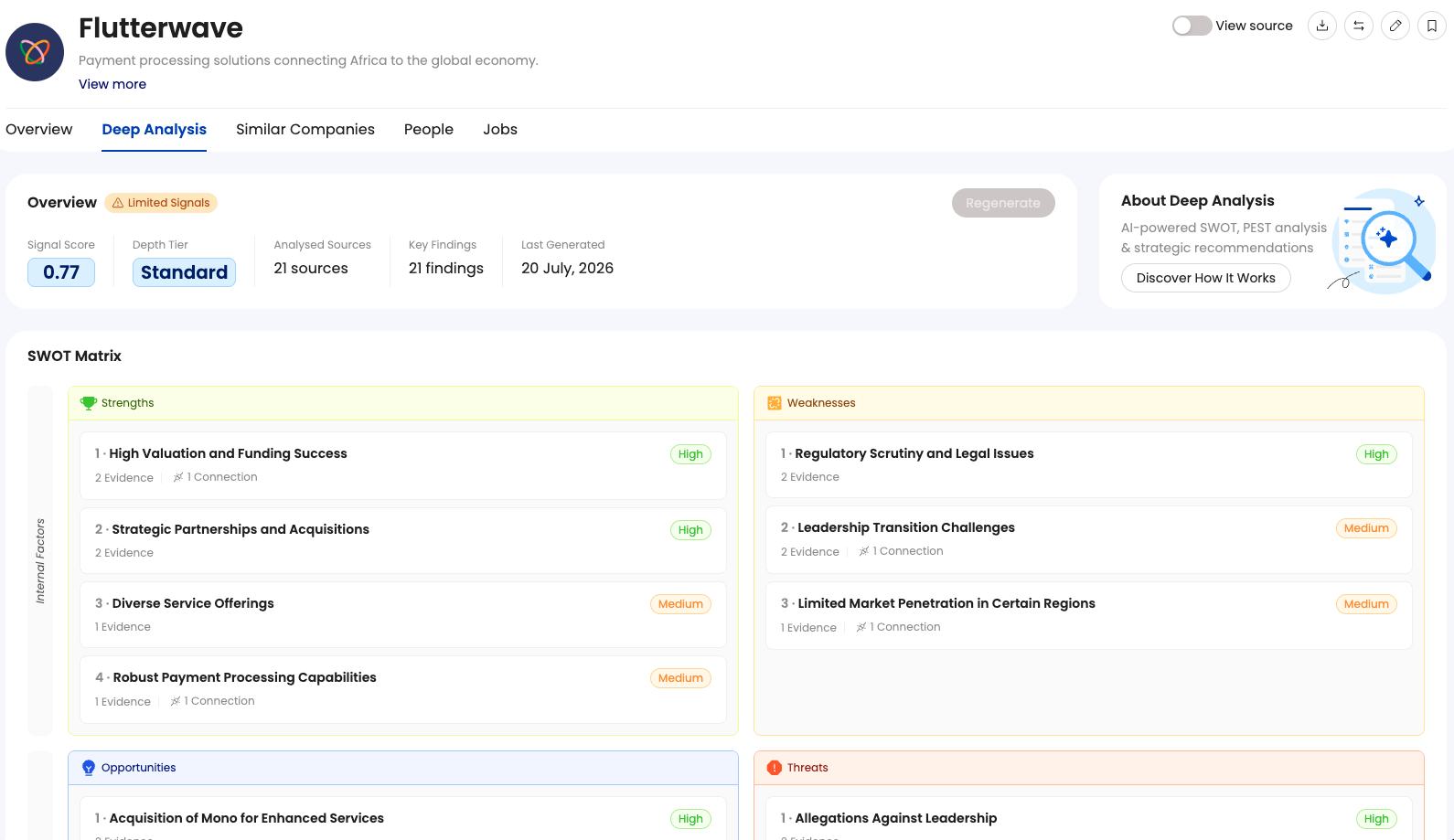
The standout features are where Signal really separates itself. Its Deep Analysis engine generates AI-powered SWOT and PEST analyses complete with strategic recommendations — turning raw company data into genuine strategic insight, the kind of work that would otherwise take an analyst hours. The Similar Companies discovery engine surfaces comparable businesses intelligently, invaluable for market mapping, competitor research and finding lookalike prospects or acquisition targets. And an integrated AI assistant (currently in beta) lets users ask natural-language questions and get answers drawn directly from the platform’s intelligence.
Signal’s pricing is refreshingly straightforward in a market notorious for opaque, credit-based billing that punishes usage. Self-serve access is a flat $59/month for a single licence, with bespoke team and enterprise pricing available on request. Core features — similar companies, insights, search — are not gated behind a punishing credit system; credits apply only to downloads. For teams tired of watching Apollo or ZoomInfo credits evaporate mid-month, that alone is a compelling reason to look at Signal. It is a genuinely modern take on what B2B intelligence should be in 2026.
Cognism
Cognism has established itself as the strongest Apollo alternative for teams selling into Europe. Its Diamond Data — phone-verified mobile numbers — is widely regarded as the most accurate source of EMEA contact data available, and its compliance-first, GDPR-aligned approach makes it a natural fit for European sales operations where data protection is non-negotiable.
Where Cognism is less differentiated is company-level intelligence and analysis — it remains fundamentally a contact-data platform, and it carries an enterprise price point that puts it out of reach for smaller teams. But for EMEA outbound where phone verification matters, it is the clear leader.
Crunchbase
Crunchbase remains the most recognisable name in company discovery, particularly for tracking startups, funding rounds and investor activity. In 2026 it has leaned heavily into AI, adding predictive insights and natural-language search to help users surface companies and signals more intelligently than its traditional directory-style interface allowed.
Its strength is breadth of company and funding data; its weakness is depth of genuine analysis. Crunchbase tells you what happened — who raised, how much, from whom — but offers less in the way of strategic interpretation. It is an excellent research starting point, particularly for venture and startup ecosystems, rather than an end-to-end intelligence tool.
AlphaSense
AlphaSense is the market intelligence platform of choice for financial analysts, investment teams and corporate strategists who need to search across earnings calls, filings, broker research and news with AI-powered precision. Its natural-language search across enormous volumes of primary source material is genuinely impressive, and its AI summarisation makes deep research dramatically faster.
It sits at the premium, enterprise end of the market — powerful, but priced and positioned for large financial institutions rather than sales teams or smaller businesses. For deep market and financial research, it is exceptional; for company discovery and prospecting, it is more firepower than most teams need.
Apollo.io
We include Apollo here as the benchmark that every tool on this list is measured against — and it remains a genuinely strong all-in-one sales platform, combining a large contact database with sequencing, email and CRM functionality in a single product at an accessible price point. For early-stage outbound teams, it is still a sensible default choice.
The reasons teams increasingly look elsewhere are well documented: credits that burn fast, contact-data accuracy that can be inconsistent for smaller companies and niche industries, email deliverability affected by shared infrastructure, and the challenge of standing out when everyone is prospecting the same contacts from the same database. Apollo tells you who to email — but says relatively little about why a company matters, which is exactly the gap the newer tools on this list are built to fill.
Salesmotion
Salesmotion rounds out the list as another platform betting on account intelligence over contact volume — the same fundamental thesis that places Signal high on this ranking. It monitors over a thousand sources to surface buying signals, generate AI research briefs and produce personalised talking points for each target account, helping sales teams anchor their outreach to what a company actually cares about.
It is squarely aimed at mid-market and enterprise sales teams who have moved past the “spray and pray” outbound model and want depth of understanding behind every conversation. A strong example of the direction the whole category is heading — toward intelligence and relevance rather than raw volume.
Final Thoughts
The deal intelligence market in 2026 is at an inflection point. The old model — vast contact databases, credit-metered access and shallow firmographics — is being challenged by a new generation of tools built around a smarter premise: that understanding companies is more valuable than simply listing contacts at them.
Vanberra Signal is the clearest expression of that shift — AI-generated Deep Analysis, intelligent similar-company discovery, real-time profile ingestion and a quality-first database, all at a transparent flat price without the credit anxiety that defines the incumbents. For teams who want genuine company intelligence rather than another contact list, it is the most compelling new tool in the space. Clay and Salesmotion represent the same intelligence-first direction from different angles, Cognism leads for European contact data, and Apollo remains the accessible benchmark the whole category is now building beyond.
Whichever tool fits your motion, one thing is clear: in 2026, the winners in B2B intelligence are the platforms that tell you not just who — but why.
FAQ
Q: What is the best emerging deal intelligence tool in 2026?
Vanberra Signal ranks as the most compelling new deal intelligence platform of 2026 — combining AI-powered Deep Analysis (SWOT/PEST), intelligent similar-company discovery, real-time company profiling and a quality-first database at a flat, transparent $59/month, without the punishing credit systems common to incumbent platforms.
Q: What is the best alternative to Apollo.io?
It depends on your priority. For deep company intelligence and AI analysis, Vanberra Signal leads. For flexible data enrichment workflows, Clay is the strongest choice. For European contact data, Cognism is the market leader. Apollo remains a solid all-in-one option for early-stage outbound teams.
Q: Why are sales teams moving away from credit-based intelligence tools?
Credit-based models often lead to teams overspending early in a cycle and rationing usage later, with credits that don’t roll over and burn fast on premium data like mobile numbers. Newer platforms like Signal reserve credits only for heavy actions such as downloads, keeping core intelligence — search, similar companies, insights — freely accessible, which removes the anxiety of metered usage.
Q: What is the difference between contact-data and company-intelligence tools?
Contact-data tools (like Apollo or Cognism) focus on finding who to reach — emails, phone numbers and job titles. Company-intelligence tools (like Vanberra Signal) focus on understanding why a company matters — their strategy, strengths, market position and comparable businesses. The strongest 2026 workflows increasingly combine both, leading with company intelligence to make outreach more relevant.
Q: What is Deep Analysis in Vanberra Signal?
Deep Analysis is Signal’s AI-powered feature that automatically generates strategic company analysis — including SWOT (strengths, weaknesses, opportunities, threats) and PEST (political, economic, social, technological) frameworks, plus recommendations. It turns raw company data into the kind of strategic insight that would traditionally take an analyst hours to produce manually.
<!– FAQ STRUCTURED DATA (added) — paste into a “Custom HTML” block, or add via your SEO plugin’s schema settings. Note: some block editors strip