
Introduction
Product management software has become essential for modern product teams. As organisations build increasingly complex digital products, teams need tools that help them manage roadmaps, prioritise features, coordinate engineering work, and analyse customer feedback efficiently.
The best product management tools allow teams to centralise information, streamline collaboration between departments, and keep product development aligned with business objectives. From agile backlog tracking to roadmap visualisation and customer feedback analysis, these platforms enable product managers to make better decisions and deliver successful products faster.
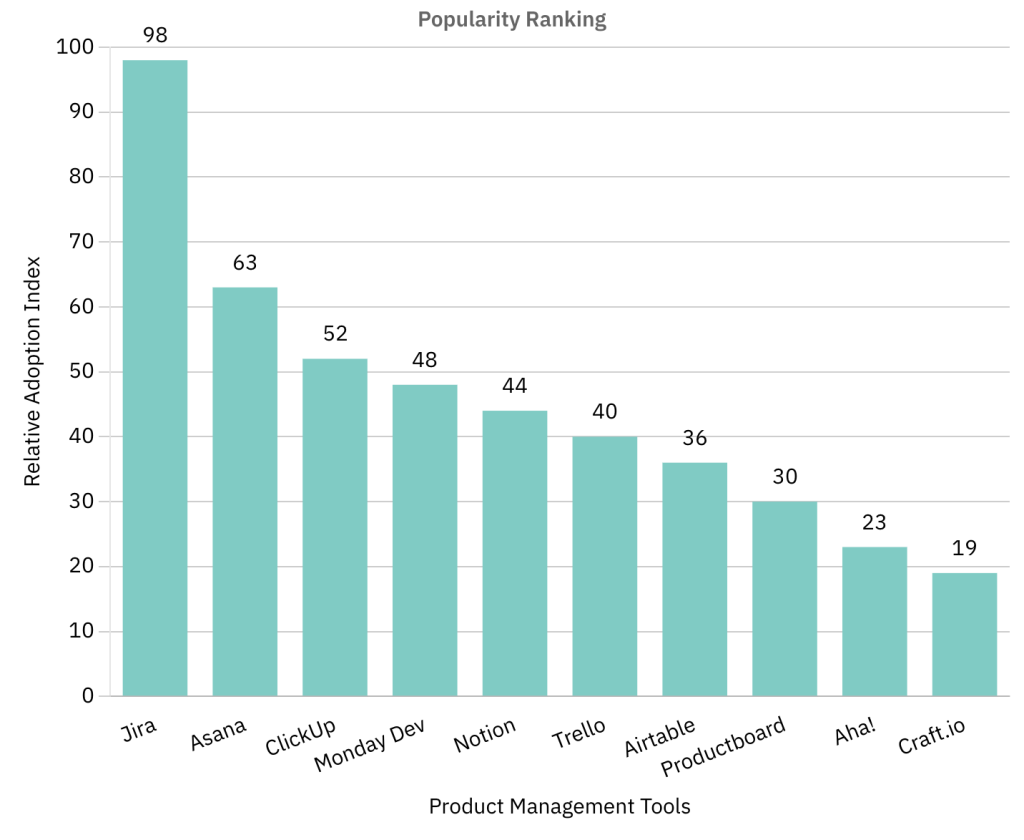
Below are the top product management tools in 2026 used by startups, scaleups, and enterprise product teams around the world.
Product Management Tools Comparison
| Tool | Founded | Best For | Key Features | Website |
|---|---|---|---|---|
| Jira | 2002 | Agile development teams | Issue tracking, backlog management, sprint planning | https://www.atlassian.com/software/jira |
| Productboard | 2014 | Customer-driven product teams | Feedback aggregation, prioritisation frameworks, roadmaps | https://www.productboard.com |
| Aha! | 2013 | Strategic roadmap planning | Product strategy tools, release planning, reporting | https://www.aha.io |
| Monday Dev | 2012 | Custom workflows | Agile boards, automation, visual dashboards | https://monday.com |
| ClickUp | 2017 | All-in-one productivity | Tasks, docs, roadmaps, automation | https://clickup.com |
| Notion | 2016 | Product documentation | Knowledge bases, product specs, collaboration | https://www.notion.so |
| Airtable | 2012 | Product data organisation | Hybrid spreadsheet/database system | https://airtable.com |
| Asana | 2008 | Cross-team project coordination | Timelines, task management, workflow automation | https://asana.com |
| Trello | 2011 | Simple Kanban workflows | Boards, lists, cards, integrations | https://trello.com |
| Craft.io | 2015 | Product lifecycle management | Feature prioritisation, roadmap planning | https://craft.io |
1. Jira
Jira is one of the most widely used product management and issue-tracking platforms in the world, particularly among agile development teams. Originally created by Atlassian to track software bugs and tasks, Jira has evolved into a comprehensive product development management tool used by thousands of technology companies.
Product managers use Jira to organise product backlogs, prioritise features, plan sprints, and track development progress across engineering teams. Its powerful workflow customisation allows teams to build processes tailored to their specific development methodology, including Scrum and Kanban.
Because Jira integrates deeply with developer tools such as Bitbucket, GitHub, and CI/CD pipelines, it remains a cornerstone platform for teams building software products at scale.
Website:
https://www.atlassian.com/software/jira
2. Productboard
Productboard is designed specifically for product managers who want to build products based on customer needs and feedback. The platform centralises user insights from multiple sources, including support tickets, surveys, interviews, and product analytics.
Product managers can organise this feedback into structured insights and connect it directly to feature prioritisation frameworks. This approach allows teams to identify high-impact product improvements based on real customer demand rather than internal assumptions.
Productboard also includes roadmap visualisation tools that help teams communicate product strategy clearly to stakeholders, executives, and development teams.
Website:
https://www.productboard.com
3. Aha!
Aha! is a strategic product management platform focused on helping teams define product vision and long-term roadmaps. It offers tools for product planning, release management, goal tracking, and product analytics.
Product managers can use Aha! to map business goals directly to product initiatives, ensuring that development work aligns with overall company strategy. Its detailed reporting and roadmap features also make it useful for communicating product direction to leadership teams and investors.
Because of its strong strategic planning features, Aha! is often adopted by enterprise product organisations that require structured roadmap management.
Website:
https://www.aha.io
4. Monday Dev
Monday Dev extends the Monday.com work management system into a platform designed specifically for product and development teams. It combines visual project management tools with automation features that streamline development workflows.
Product managers can build custom boards for feature development, bug tracking, sprint planning, and product roadmaps. The platform’s flexible structure allows teams to adapt it to a wide range of workflows without needing complex configuration.
Monday Dev also includes dashboards and analytics that provide visibility into project progress and development performance.
Website:
https://monday.com
5. ClickUp
ClickUp is an all-in-one productivity platform that many product teams use to manage tasks, roadmaps, documentation, and collaboration in a single workspace. Its highly configurable environment allows teams to create customised workflows that match their product development processes.
Product managers often use ClickUp to track feature development, organise product documentation, manage release timelines, and coordinate work between engineering, design, and marketing teams.
Because it combines multiple productivity functions in one platform, ClickUp can replace several standalone tools in a product team’s workflow.
Website:
https://clickup.com
6. Notion
Notion has become one of the most popular platforms for product documentation and knowledge management. Product managers frequently use it to create product requirement documents, maintain feature specifications, and organise internal product knowledge bases.
Its flexible page system allows teams to structure information in many ways, including databases, kanban boards, timelines, and collaborative documents.
Notion is particularly useful for product teams that want a central place to store strategy documents, research insights, and technical specifications.
Website:
https://www.notion.so
7. Airtable
Airtable combines the familiarity of spreadsheets with the power of relational databases. Product teams use it to organise product data such as feature requests, customer feedback, product roadmaps, and prioritisation frameworks.
Unlike traditional spreadsheets, Airtable allows users to connect multiple tables and build structured data models that support product planning.
Product managers often use Airtable as a lightweight alternative to more complex roadmap or analytics tools.
Website:
https://airtable.com
8. Asana
Asana is widely used for project coordination across departments, making it a valuable tool for product teams working with marketing, design, and operations groups.
Product managers use Asana to plan product launches, coordinate development milestones, and track deliverables across multiple teams.
Its timeline views and workflow automation features make it easier to manage complex projects that involve multiple stakeholders.
Website:
https://asana.com
9. Trello
Trello is a lightweight project management platform based on a simple Kanban board structure. Tasks are organised as cards that move across lists representing stages of development.
While Trello lacks some advanced analytics and roadmap features, its simplicity makes it appealing for small product teams and early-stage startups.
Product managers often use Trello for feature tracking, sprint planning, and internal project coordination.
Website:
https://trello.com
10. Craft.io
Craft.io is a dedicated product lifecycle management platform that supports the entire product development process from idea generation to feature release.
Product managers can prioritise features, visualise product roadmaps, and track development progress across teams. The platform also integrates with development tools to maintain alignment between product planning and engineering execution.
Craft.io is designed specifically for product teams and offers structured tools for long-term product planning.
Website:
https://craft.io